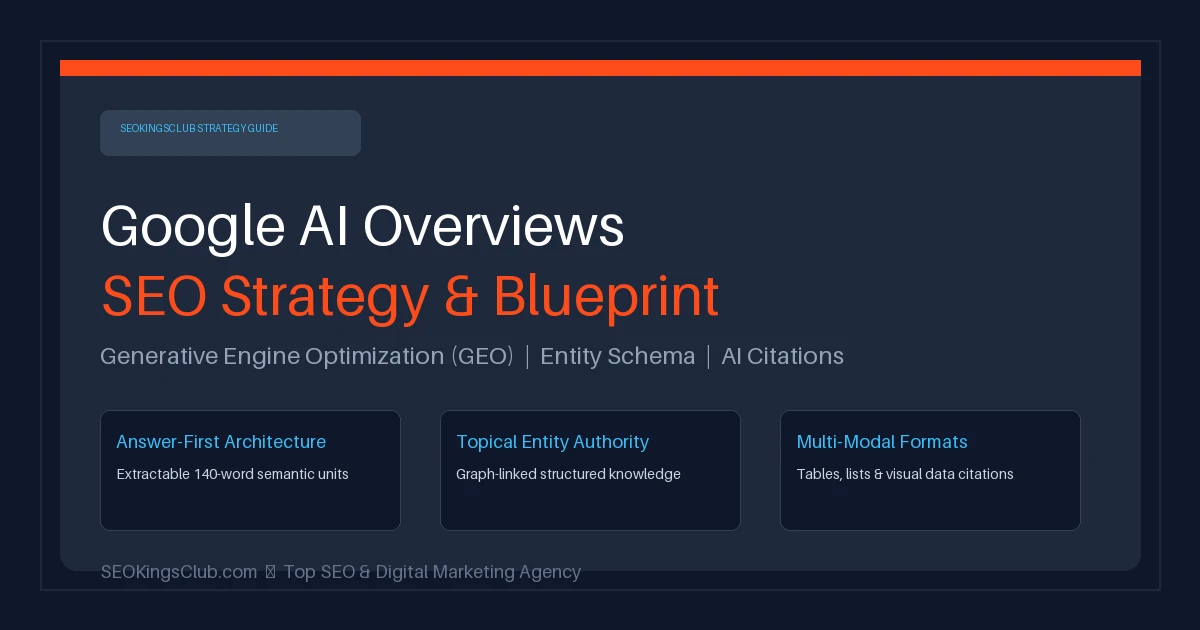
Search engine optimization has entered its most consequential transition since the shift to mobile-first indexing. With Google rolling out AI Overviews across billions of daily search queries worldwide, the mechanics of organic visibility have evolved. The traditional battle for the coveted “#1 blue link” is now shared with a new frontier: Generative Engine Optimization (GEO) and Answer Engine Optimization (AEO).
When an AI Overview triggers at the top of a search engine results page (SERP), it synthesizes insights from multiple web sources into a unified, direct answer. For forward-thinking brands, this represents an extraordinary opportunity: winning a cited source card within an AI Overview frequently yields higher qualified engagement, stronger brand credibility, and superior buyer intent than standard organic snippets. However, succeeding in this environment requires an intentional, data-backed Google AI Overviews SEO strategy.
At SEOKingsClub, we work with high-growth businesses and enterprise brands to adapt their digital footprint for the modern search landscape. In this comprehensive guide, we dissect exactly how Google’s generative models select citations, the technical and on-page ranking factors that influence AI inclusion, and the step-by-step framework you need to capture top AI visibility.
What Are Google AI Overviews and Why Do They Matter?
Google AI Overviews (formerly part of the Search Generative Experience, or SGE) use custom Gemini-powered large language models to generate concise, multi-source answers for complex user queries. Rather than requiring searchers to click through multiple independent pages to piece together information, Google’s AI synthesizes the answers directly onto the SERP and embeds clickable source links (“citation chips” and interactive sidecar cards).
According to search engine studies, AI Overviews trigger most frequently on:
- Multi-step informational queries: Detailed “how-to” and troubleshooting questions.
- Comparison and evaluation searches: Queries weighing alternatives, software features, or methodology pros and cons.
- Commercial and product-intent searches: Buyer guides, local service evaluations, and category breakdowns.
If your website relies solely on outdated keyword density and thin content, you risk losing search market share to competitors who structure their content for AI extractability. Implementing modern strategic search engine optimization services ensures your brand remains a recognized authority across both generative snapshots and classic organic results.
Traditional SEO vs. Generative Engine Optimization (GEO)
To win AI citations consistently, SEOs must understand the fundamental shift from keyword matching to entity extraction and semantic completeness.
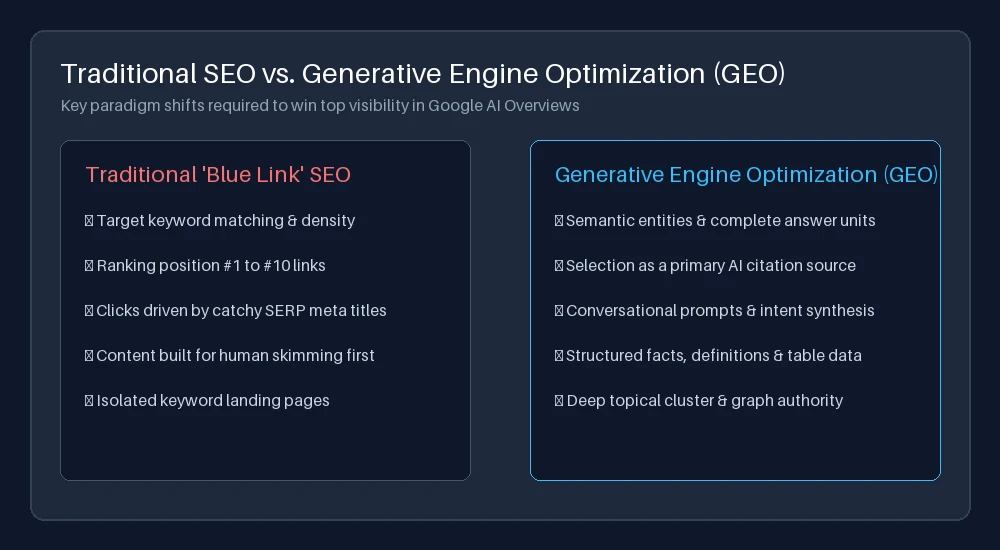
Figure 1: Core differences between classic ten-blue-link SEO and Generative Engine Optimization (GEO).
| SEO Dimension | Traditional “Blue Link” SEO | Generative Engine Optimization (GEO) |
|---|---|---|
| Primary Target | Individual keyword rankings (Pos #1–10) | Direct AI synthesis & citation card placement |
| Content Format | Long-form text with scattered keywords | Self-contained, extractable 130–170 word answer blocks |
| Algorithm Focus | Anchor text, PageRank, title tag match | Entity consensus, semantic depth & E-E-A-T trust signals |
| Data Structure | Basic metadata & Open Graph tags | Deep JSON-LD Schema (Article, FAQ, HowTo, Organization) |
Key Ranking Factors Influencing AI Overview Inclusion
Google’s AI models do not pull information randomly. They rely on an information retrieval pipeline that scores candidate passages based on specific quality and structural benchmarks:
1. Semantic Completeness and Standalone Answer Units
Language models reward passages that answer a specific sub-question thoroughly without requiring prerequisite context. Empirical data shows that passages between 130 and 170 words featuring clear cause-and-effect explanations, defined terminology, and factual precision have the highest extraction probability.
2. Verified E-E-A-T and Author Entity Credentials
Google utilizes its Knowledge Graph and entity reconciliation systems to verify the expertise behind content. Articles written by named authors with explicit credentials, verifiable experience, and transparent institutional affiliations are heavily favored over anonymous copy.
3. Information Gain and Unique Perspectives
Google’s patent on “Information Gain Scores” explicitly penalizes pages that simply regurgitate what existing top-ranking articles state. To earn an AI Overview citation, your content must offer fresh data, practical case studies, proprietary benchmarks, or nuanced expert analysis.
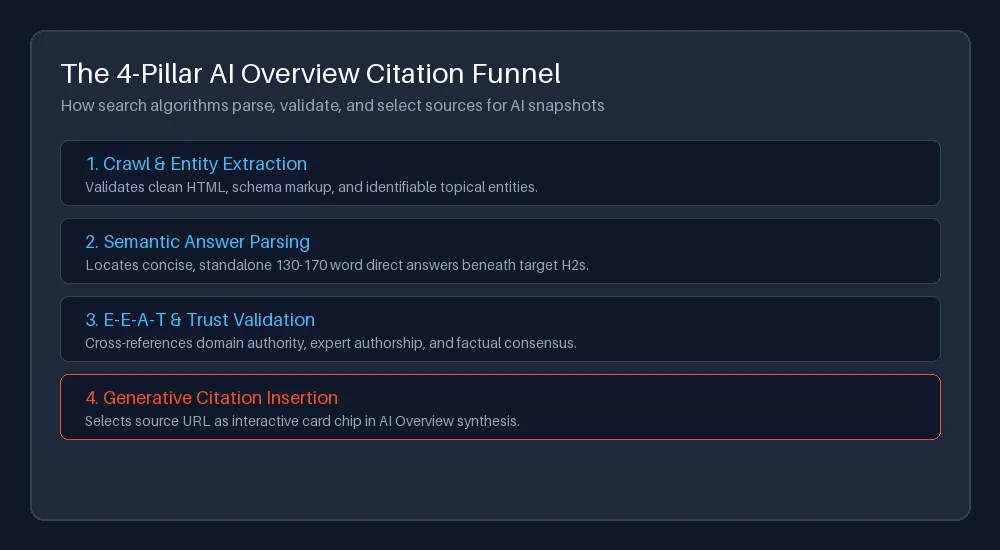
Figure 2: The 4-pillar selection pipeline Google’s AI models follow to cite authoritative web sources.
The 5-Step Action Blueprint to Optimize for Google AI Overviews
Step 1: Implement an “Answer-First” Content Architecture
Structure every primary section of your content using an inverted pyramid format. Place the direct, unambiguous answer immediately beneath each H2 or H3 heading before expanding into technical nuances, examples, and edge cases.
For example, if your heading is “How does structured data impact AI search?”, your first sentence should state: “Structured data provides machine-readable schema markup that helps generative AI models identify topical entities, verify factual claims, and connect relational data.” Then follow with implementation steps and code snippets.
Step 2: Fortify Your Technical and On-Page Foundation
AI models cannot cite what search crawlers cannot rapidly index. Clean DOM architecture, zero rendering blockers, and swift Core Web Vitals are foundational. Incorporating a dedicated technical and on-page SEO service ensures your site hierarchy, internal canonical tags, and HTML headers are fully optimized for seamless LLM ingestion.
Step 3: Deploy Nested Entity Schema Markup
Schema markup serves as an explicit translation layer for search engine models. Implement rich JSON-LD markup across your website, including:
- Article Schema: Indicating author entity, publishing organization, dates, and mainEntityOfPage.
- FAQPage Schema: Structuring common queries directly for algorithmic extraction.
- Organization & SameAs Schema: Linking your brand to official Wikidata, Crunchbase, LinkedIn, and industry directory profiles.
Step 4: Build Authoritative Topical Clusters
Isolated blog posts rarely earn high-authority AI citations. Instead, create comprehensive topical hubs where pillar pages link contextually to deep-dive subtopics. For technology and B2B companies, leveraging specialized SaaS SEO agency solutions creates the necessary topical density to establish undisputed domain authority.
Step 5: Prioritize Multi-Modal Information Formatting
Generative models frequently extract data from structured visual assets. Enhance your written guides with:
- High-contrast HTML comparison tables with clear
<th>headings. - Step-by-step numbered process workflows.
- Original diagrams and infographics with descriptive alt text and captions.
Combining visual data with authoritative content marketing maximizes your chance of being featured across both textual AI Overviews and visual SERP carousels.
How to Track and Measure AI Overview SEO Performance
Because Google Search Console currently aggregates AI Overview impressions and clicks within standard organic search data, measuring GEO performance requires a strategic methodology:
- Track Citation Appearance Rates: Use modern SERP tracking tools to monitor queries where your domain appears inside the AI Overview citation box versus standard organic positions.
- Monitor High-Intent Assisted Conversions: Users who click through from an AI Overview have already consumed a high-level summary and arrive with deeper evaluation intent. Track conversion rates on referenced landing pages.
- Measure Branded Entity Search Growth: As your brand is cited repeatedly in generative summaries, unprompted brand search volume and direct referral queries consistently increase.
Frequently Asked Questions (FAQs)
How do I optimize my website for Google AI Overviews?
To optimize for Google AI Overviews, implement an answer-first content structure with 130–170 word concise summaries below headings, use comprehensive JSON-LD schema markup, establish strong author E-E-A-T credentials, and create deep topical content clusters supported by original data and multi-modal comparison tables.
Does structured data help with AI Overview visibility?
Yes. Structured data (JSON-LD) provides machine-readable context that allows Google’s generative models to easily identify entities, understand relationships between concepts, and verify factual data, significantly increasing the probability of your content being selected as an AI source citation.
How does Google select source websites for AI Overviews?
Google selects sources based on topical authority, semantic relevance, consensus across the Knowledge Graph, clear informational formatting, high domain trust (E-E-A-T), and whether the page provides unique Information Gain that complements the synthesized response.
What is the difference between traditional SEO and Generative Engine Optimization (GEO)?
Traditional SEO focuses on ranking ten blue links through keyword placement, metadata, and link authority. Generative Engine Optimization (GEO) focuses on optimizing modular content units, semantic entities, and direct answers so AI search engines cite your brand inside synthesized summaries.
Will AI Overviews reduce website traffic?
While simple informational queries may experience lower CTR due to zero-click answers, commercial, comparison, and technical queries that earn AI source citations often receive higher-quality, qualified traffic with significantly higher conversion rates.
Future-Proof Your Search Visibility with SEOKingsClub
The transition to AI-powered search is not a future projection—it is happening now. Brands that adapt their content architecture, technical schema, and topical authority today will dominate search engine visibility for years to come.
At SEOKingsClub, our search specialists build custom SEO strategies designed to maximize your presence across traditional organic search, AI Overviews, and emerging generative platforms. Ready to evaluate your site’s AI readiness? Request a free SEO audit and consultation today and discover how our data-driven strategies can accelerate your organic growth.