Enterprise Ecommerce SEO Strategy: Framework and Execution
An enterprise ecommerce SEO strategy orchestrates technical crawl efficiency, taxonomy governance and algorithmic internal linking across websites with hundreds of thousands of product URLs. Core strategic execution focuses on resolving faceted navigation indexing bloat, automating canonical hierarchies and distributing PageRank through automated breadcrumbs. Enterprise brands that master programmatic optimization achieve dominant organic visibility across hyper-competitive transactional search queries.
Managing organic search performance for large-scale retail storefronts involves technical complexities that standard brochure websites never face. When an online catalog expands beyond one hundred thousand SKUs, routine algorithmic updates can trigger massive indexation drops.
Faceted filtering systems often generate millions of duplicate parameter combinations, trapping search engine spiders in infinite crawling loops. Without disciplined engineering protocols, valuable crawl budget is wasted on low-value sorting URLs rather than core commercial landing pages.
Marketing executives planning comprehensive organic campaigns can review our analysis on enterprise SEO services for organizational workflow models. Establishing robust technical frameworks ensures sustainable revenue expansion across global consumer markets.
Enterprise Ecommerce Technical SEO Governance Matrix
Analyzing primary catalog layers clarifies the specific engineering controls required to maintain flawless search engine discoverability.
| Catalog Architecture Layer | Primary Technical Challenge | Recommended Engineering Solution | Business Impact on Organic Revenue |
|---|---|---|---|
| Top-Level Category Hubs | Keyword cannibalization across sub-genres | Strict parent-child hierarchical taxonomy | Captures high-volume commercial head terms |
| Faceted Filter Attributes | Exponential duplicate URL parameters | AJAX client rendering or selective indexing | Preserves crawl budget for converting pages |
| Product Detail Pages (PDP) | Out-of-stock items and orphan URLs | Dynamic related product links and schema | Protects long-tail transactional rankings |
| Seasonal Promotional Hubs | Broken backlinks after holiday sales | Permanent evergreen URLs with updated products | Retains accumulated historical page authority |
Aligning development sprints with search architecture requirements prevents unexpected indexing regressions during major commercial product launches.
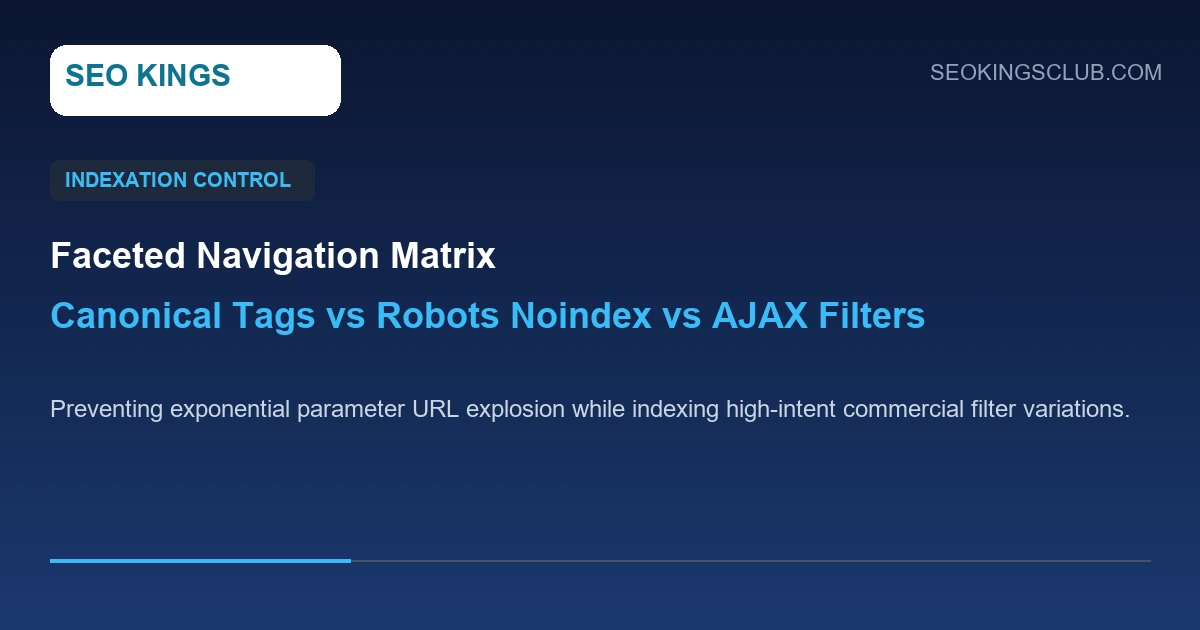
Taming Faceted Navigation and Parameter Indexation Traps
Faceted navigation provides exceptional user shopping utility by helping consumers refine product catalogs across sizes, colors, brands and prices. However unrestricted URL parameter generation can multiply a fifty-thousand product catalog into five million crawlable URL variations.
Search bots encountering unchecked parameter combinations exhaust their daily crawling quotas without ever discovering newly released inventory. Enterprise engineering teams resolve this challenge by implementing selective indexation rules governed by documented search query demand.
High-search-volume filter combinations like brand plus category pairings should generate clean static URLs equipped with unique self-referencing canonical tags. In contrast multi-attribute combinations involving price sorting or sizing should be handled via client-side JavaScript or blocked via robots directives.
Retail teams upgrading platform capabilities can consult our strategic breakdown on ecommerce SEO services for technical audit checklists. Establishing strict parameter controls safeguards crawl efficiency across every seasonal catalog refresh.
In addition developers should implement rel canonical tags pointing secondary parameter permutations back toward primary canonical category endpoints. Automated testing pipelines must verify canonical tags after every major platform code deployment to prevent silent indexing failures. Engineering teams should monitor server log files weekly to identify rogue query parameters consuming excessive bot bandwidth.
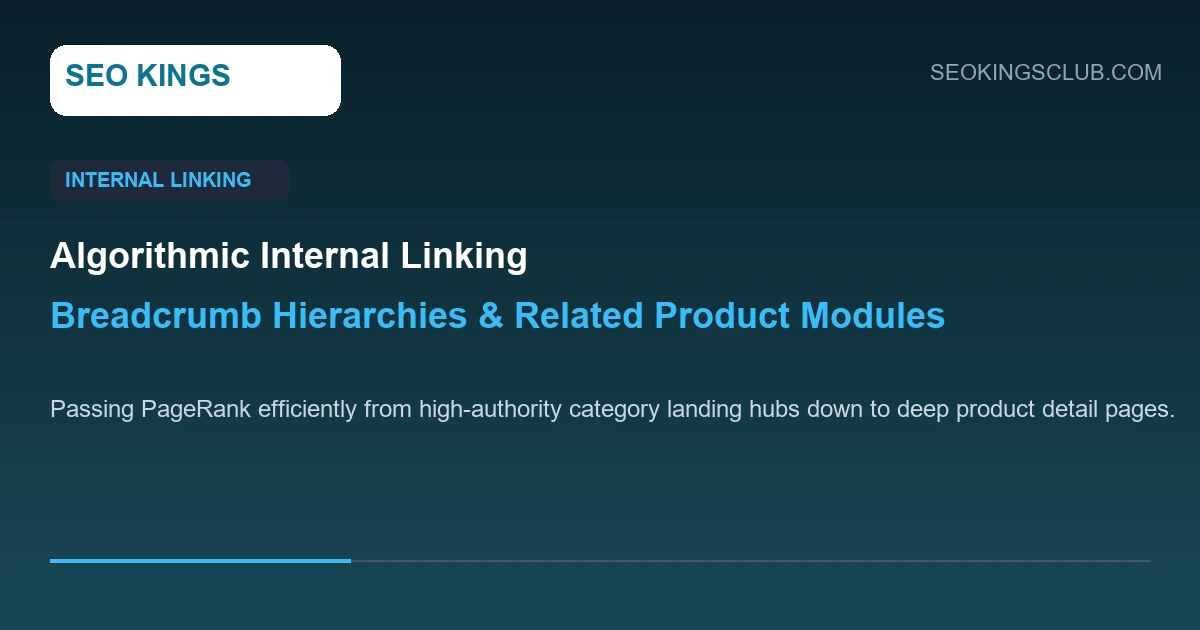
Algorithmic Internal Linking and PageRank Distribution
In massive digital catalogs, product detail pages buried five clicks away from the homepage rarely receive adequate PageRank to rank organically. Overcoming deep catalog isolation requires automated internal linking modules built directly into the site information architecture.
Implementing structured JSON-LD breadcrumb hierarchies establishes clear semantic parent-child relationships that search engine algorithms understand immediately. In addition dynamic merchandising widgets like related products and frequently bought together modules establish horizontal link paths across related categories.
SEO directors managing cross-category link distribution can review our detailed analysis of programmatic SEO internal linking architecture for algorithmic modeling techniques. Algorithmic internal links ensure fresh inventory receives immediate crawl discovery and search equity.
Regular log file analysis verifies that Googlebot crawls deep catalog levels consistently without stalling on discontinued merchandise pages. Discontinued items should return appropriate HTTP status codes or display relevant replacement models to retain prospective buyer traffic. Automating contextual links within product descriptions passes topical relevance directly between related product variants. Strategic internal link placement helps newly published product pages accumulate indexation signals within hours of release.
Advanced Product Schema and Merchant Center Integrations
Modern consumers increasingly discover products directly within Google organic shopping carousels and visual merchant displays. Securing prominent visual product snippets requires automated implementation of comprehensive Product and Offer structured data markup.
Every product detail page must dynamically populate exact price specifications, currency codes, availability status and verified customer review aggregates. Integrating Merchant Center product feeds with organic schema markup builds algorithmic trust, improving visual visibility across mobile shopping interfaces.
Rich snippets featuring gold star ratings and real-time inventory badges dramatically elevate organic click-through rates against competing retail listings. Implementing automated structured data validation scripts prevents syntax errors from invalidating merchant rich results during high-traffic sales periods.

Managing Out-of-Stock and Discontinued Product Lifecycles
Mishandling temporary inventory stockouts represents one of the most common causes of organic traffic erosion across large enterprise storefronts. Deleting out-of-stock product pages or redirecting them indiscriminately to the homepage destroys accumulated backlink equity and creates soft 404 errors.
For temporarily sold-out merchandise, the product URL should remain active with clear messaging regarding expected replenishment dates. Including email notification sign-up forms keeps interested consumers engaged while preserving existing organic keyword rankings.
When items are permanently retired, teams should evaluate backlink metrics and historical search traffic before selecting an appropriate redirection path. Products possessing valuable external backlinks should be redirected using permanent 301 redirects to the closest equivalent replacement item. Preserving URL equity through intelligent redirection protects domain authority across multi-year retail merchandising cycles. Establishing clear product retirement guidelines prevents commercial catalogs from accumulating thousands of orphaned indexable pages. Server-side rendering frameworks accelerate page load speeds across high-volume product listing directories. Compressing high-resolution catalog imagery reduces total page weight without compromising visual merchandise presentation. Technical search audits should examine canonical header tags across mobile and desktop responsive views. Automating inventory status notifications preserves organic search rankings for temporarily out-of-stock product variants. Optimizing collection landing page copy with secondary commercial keywords captures valuable middle-of-funnel shoppers. Continuous server monitoring ensures high availability during sudden traffic surges generated by promotional marketing events. Enterprise engineering teams must coordinate technical optimizations across multiple international storefront locales.
Frequently Asked Questions on Enterprise Ecommerce SEO
How does faceted navigation harm ecommerce SEO performance?
Uncontrolled faceted navigation generates millions of duplicate parameter URLs, exhausting search bot crawl budgets and diluting domain ranking signals.
What is the best way to handle permanently discontinued products?
Permanently discontinued products with high external backlinks should be 301 redirected to closely matching replacement products or parent categories.
How can enterprise retailers optimize crawl budget effectively?
Retailers optimize crawl budget by blocking low-value filter combinations, optimizing internal link structures and resolving redirect chains.
Why is structured data markup essential for ecommerce websites?
Product schema markup enables eye-catching rich snippets including price badges, stock availability and star ratings within organic search results.
How often should enterprise ecommerce sites analyze server log files?
Enterprise search teams should analyze server logs weekly to monitor bot crawling patterns and identify newly emerging indexing bottlenecks.