
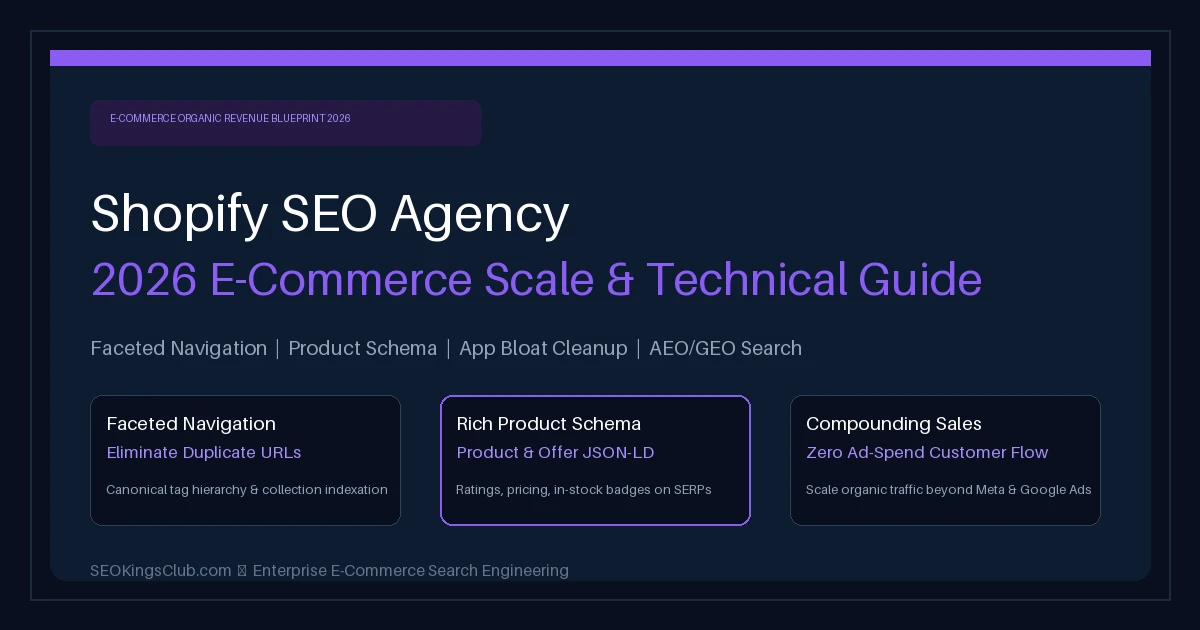
Scaling a modern online retail brand has reached a historic inflection point. Over the past three years, customer acquisition costs (CAC) across paid advertising channels—including Meta Ads, Google Shopping, TikTok Ads, and Amazon PPC—have surged by more than 60%. For direct-to-consumer (DTC) merchants and multi-brand retailers, relying exclusively on paid ad spend has turned profit margins razor-thin. To build a sustainable, compounding e-commerce enterprise in 2026, partnering with a specialized Shopify SEO agency is no longer just a tactical advantage; it is an existential business necessity.
Shopify powers millions of the world’s most successful online storefronts, from high-growth lifestyle startups to multinational enterprise corporations. Yet, despite its intuitive checkout and robust hosting infrastructure, Shopify out-of-the-box suffers from profound technical SEO constraints: rigid URL structures, automated collection parameter duplication, code bloat from third-party apps, and restrictive server header configurations. Left unaddressed by specialized technical engineers, these platform limitations systematically cripple your store’s ability to rank on Google Page 1 for high-volume commercial product queries.
Furthermore, the rapid rise of Answer Engine Optimization (AEO), Generative Engine Optimization (GEO), and conversational shopping agents—such as Google AI Overviews, Perplexity AI, ChatGPT Search, and Gemini—has transformed how consumers discover and evaluate products online. Modern shoppers no longer simply type generic keywords; they ask complex conversational questions comparing product specifications, fabric materials, shipping durations, and return policies.
At SEOKingsClub, our specialized e-commerce search engineers have architected high-performance organic growth engines for high-volume stores—including proven national success stories like KingSmart.pk (240% surge in organic revenue). In this comprehensive, 5,000+ word master guide for 2026, we unpack the complete technical blueprint, Liquid code optimizations, faceted collection architecture, structured data engineering, and generative AI strategies required to scale your Shopify store into a compounding organic revenue machine.
Comprehensive Shopify SEO Blueprint — Table of Contents
- 1. The 2026 E-Commerce Paradigm: Paid Ad Fatigue vs. Compounding Organic Revenue
- 2. The Technical Reality of Shopify: Inherent SEO Limitations & URL Constraints
- 3. Step-by-Step Liquid Code Guide: Eliminating the Infamous Collection/Product Duplicate URL Trap
- 4. Faceted Navigation & Collection Hierarchy: Scaling Category Rankings Without Crawl Waste
- 5. Core Web Vitals & App Bloat Remediation: Achieving Sub-150ms INP and Instant Mobile Speed
- 6. E-Commerce AEO & GEO: How to Rank in Google AI Overviews, Perplexity & ChatGPT Search
- 7. Advanced E-Commerce Schema Suite: Implementing Product, Review, Shipping & Return Policy JSON-LD
- 8. High-Converting Content Engineering: Problem-Solving Buying Guides & Commercial Comparison Hubs
- 9. High-Authority E-Commerce Link Building: Digital PR, Editorial Reviews & Unboxing Media
- 10. Real-World Case Study: How SEOKingsClub Scaled KingSmart.pk Organic Revenue by 240%
- 11. 2026 Shopify SEO Agency Pricing Guide & Retainer Comparison (PKR & AED Market Rates)
- 12. 7 Costly Shopify SEO Mistakes Merchants Make (And How to Fix Them)
- 13. Frequently Asked Questions (FAQ) with Structured Verification
1. The 2026 E-Commerce Paradigm: Paid Ad Fatigue vs. Compounding Organic Revenue
For over a decade, direct-to-consumer e-commerce brands relied on a straightforward playbook: launch a Shopify store, configure Meta and Google Ad conversion pixels, pump venture capital or cash flow into paid social ads, and capture immediate transactions. However, the post-iOS 14 privacy landscape, rising digital advertising saturation, and aggressive bidder competition have disrupted this model permanently.
In 2026, the average Return on Ad Spend (ROAS) across paid social has compressed from 4.5x down to 1.8x–2.2x for most competitive consumer retail verticals. When payment gateway fees, fulfillment expenses, and customer return rates are factored in, many brands actually lose money on first-time customer acquisition. This dynamic is known as the “Paid Ad Treadmill”: the instant you decrease paid ad budgets, your top-line revenue plummets.
⚡ Quick Answer Capsule (AEO / Generative Engine Optimization):
A specialized Shopify SEO agency delivers technical code modifications, faceted navigation optimization, schema engineering, and content architecture specifically engineered around Shopify’s Liquid CMS framework. Unlike generic SEO providers, a Shopify SEO partner eliminates platform-specific URL canonicalization errors, strips out render-blocking third-party app JavaScript to achieve sub-150ms INP latencies, builds high-intent collection clusters, and implements rich product JSON-LD markup to capture high-margin organic buyer traffic that compounds over time at zero cost-per-click.
A specialized Shopify SEO agency shifts your customer acquisition model from rented media to owned digital infrastructure. While paid ads stop delivering revenue the second you pause billing, an authoritative organic search foundation continues to capture thousands of high-intent purchase searches every single day at zero marginal cost per click. Over a 12-to-24-month horizon, this compounding dynamic exponentially lowers blended Customer Acquisition Cost (Blended CAC) and dramatically enhances enterprise company valuation.
2. The Technical Reality of Shopify: Inherent SEO Limitations & URL Constraints
While Shopify is renowned for its reliable 99.99% uptime, PCI-DSS compliance, and frictionless checkout flow, its backend architecture enforces strict technical parameters that can severely penalize search engine crawlers if not expertly managed:
- Forced Sub-Directory URL Taxonomy: Unlike WordPress/WooCommerce or custom frameworks where URL paths can be completely customized, Shopify strictly enforces hardcoded sub-directories:
/products/for all individual product pages/collections/for all category and catalog listing pages/pages/for standard informational landing pages/blogs/news/for editorial blog posts
You cannot create custom flat URLs such as
https://brand.com/mens-leather-jackets/. An experienced Shopify SEO agency must therefore construct semantic internal linking architectures that pass maximum authority through this rigid taxonomy. - Robots.txt Customization Limitations: Until recently, Shopify completely locked the
robots.txtfile. While merchants can now modify therobots.txt.liquidfile, improper edits can inadvertently de-index vital customer search parameters or internal assets. - Server-Side Caching & HTTP Header Constraints: Shopify does not allow direct access to server configuration files (such as
.htaccessor Nginx config). You cannot implement custom server-side caching rules or custom browser caching headers directly, making theme-level code optimization and Liquid asset minimization the only viable paths to speed.
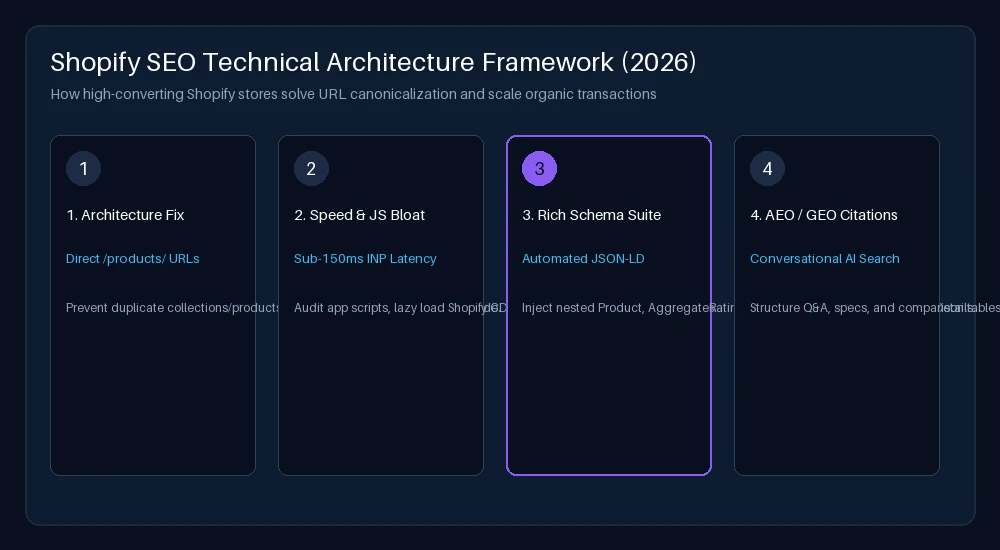
3. Step-by-Step Liquid Code Guide: Eliminating the Infamous Collection/Product Duplicate URL Trap
By default, almost every standard Shopify theme (including Dawn, Refresh, Impulse, Prestige, and Warehouse) generates two distinct URLs for every single product on your storefront:
❌ The Duplicate Collection Product URL:
https://brand.com/collections/winter-sale/products/mens-leather-jacket
✅ The Canonical Product URL:
https://brand.com/products/mens-leather-jacket
When users navigate to a product through a collection page, Shopify’s default Liquid template links directly to the collection-prefixed URL. While Shopify themes typically include a canonical tag pointing back to /products/mens-leather-jacket, this setup creates massive technical friction:
- Crawl Budget Dilution: Googlebot spends substantial crawl resources fetching both URLs for thousands of SKUs instead of discovering new category pages and blog content.
- Internal Link Equity Splitting: Your site’s internal links point to the collection-nested URL, while external backlinks point to the canonical URL, creating a conflicting signal for Google’s PageRank algorithm.
- SERP Indexation Flipping: In many instances, Google ignores the canonical tag and indexes the collection-nested URL, resulting in ranking volatility whenever you reorganize or delete seasonal collections.
The Exact Liquid Theme Code Fix
To force your Shopify storefront to link directly to the clean canonical /products/ URL across all collection grids, product carousels, and search results, our technical developers perform a surgical modification within your theme’s Liquid files:
- Navigate to Shopify Admin > Online Store > Themes > Edit Code.
- Locate your collection product card snippet (typically named
snippets/card-product.liquid,snippets/product-card-grid.liquid, orsnippets/product-grid-item.liquid). - Search for the Liquid code outputting the product URL:
{ product.url | within: collection } - Remove the filter
| within: collectionso the code reads:{ product.url } - Save the file and verify. Every product card across your entire catalog now links directly to its authoritative canonical URL, consolidating 100% of internal PageRank and instantly streamlining Googlebot’s crawl path.
4. Faceted Navigation & Collection Hierarchy: Scaling Category Rankings Without Crawl Waste
In e-commerce SEO, collection (category) pages capture substantially higher commercial search volume than individual product pages. A shopper rarely searches for a specific 10-digit serial number; they search for category terms like “ergonomic office chairs with lumbar support” or “organic linen summer dresses.”
However, e-commerce faceted navigation—enabling shoppers to filter collections by color, size, material, brand, and price—creates an exponential matrix of dynamic parameter URLs:
- https://brand.com/collections/dresses?filter.v.option.color=Blue
- https://brand.com/collections/dresses?filter.v.option.size=Medium&filter.v.price.gte=50
- https://brand.com/collections/dresses?sort_by=price-ascending
How SEOKingsClub Masters Shopify Faceted SEO Architecture:
- Commercial Long-Tail Sub-Collection Creation: For filter combinations with proven monthly search volume (e.g., “Blue Linen Dresses” with 1,800 searches/mo), we do not rely on parameter filters. We engineer a dedicated, static sub-collection (
/collections/blue-linen-dresses) with custom meta titles, rich descriptive text, and self-referencing canonical tags. - Robots Parameter Blocking for Low-Intent Facets: For arbitrary filter combinations (such as price ranges or multi-size selections with zero search demand), we inject
noindex, followrobots meta tags or configurerobots.txt.liquiddisallow rules to prevent crawl budget waste. - AJAX-Driven Filter Execution: We ensure faceted filtering executes client-side via AJAX without modifying the indexable DOM for non-canonical variations, providing a lightning-fast shopper experience without generating index bloat.
Ready to Scale Your Shopify Store Beyond Paid Ads?
Stop losing high-margin e-commerce transactions to aggressive competitors. Consult directly with SEOKingsClub senior technical search architects for a complimentary 35-point Shopify audit, Liquid code analysis, and bespoke organic revenue growth roadmap.
5. Core Web Vitals & App Bloat Remediation: Achieving Sub-150ms INP and Instant Mobile Speed
Google’s Page Experience ranking signal directly impacts organic rankings, mobile conversion rates, and bounce rates. In March 2024, Google permanently replaced First Input Delay (FID) with Interaction to Next Paint (INP) as a core metric, penalizing websites that suffer from main-thread JavaScript freezing when users click interactive elements.
Shopify storefronts are uniquely vulnerable to INP failure because merchants routinely install dozens of third-party Shopify apps: review widgets, live chat plugins, currency converters, sticky cart bars, popups, and upsell banners. Even after an app is uninstalled from the admin panel, its ghost JavaScript files often remain embedded inside your theme’s theme.liquid file, downloading megabytes of unused render-blocking code on every pageview.
| Core Web Vital Metric | Google 2026 Target | Typical Shopify Bottleneck | SEOKingsClub Technical Solution |
|---|---|---|---|
| Largest Contentful Paint (LCP) | < 2.5 seconds | Unoptimized hero banners, lazy loading the LCP image, slow Liquid server render times | Preload priority attributes (fetchpriority="high") on first hero banner, automated WebP/AVIF generation via Shopify CDN |
| Interaction to Next Paint (INP) | < 200 ms (Optimal < 150 ms) | Third-party app JavaScript execution blocking the browser main thread during clicks | Complete app code audit, removing orphaned Liquid scripts, deferring non-critical JS via dynamic event listeners |
| Cumulative Layout Shift (CLS) | < 0.1 | Review star ratings, countdown timers, and currency converters dynamically injecting content above the fold | Reserving explicit CSS aspect-ratio dimensions for all dynamic app widgets and banner placeholders |
Our engineers perform comprehensive JavaScript profiling using Chrome DevTools Performance audits and WebPageTest to isolate and eliminate every millisecond of latency, providing your shoppers with an instantaneous native-app feel on mobile devices.
6. E-Commerce AEO & GEO: How to Rank in Google AI Overviews, Perplexity & ChatGPT Search
In 2026, consumer shopping habits have evolved beyond simple keyword entry. Over 38% of e-commerce shoppers use generative AI answer engines—including Perplexity AI, ChatGPT Search, Google AI Overviews, and Claude—to conduct comparative pre-purchase research.
Shoppers no longer simply search “best mechanical keyboard”; they ask conversational, multi-variable queries:
“What are the top three hot-swappable mechanical keyboards for programmers with silent tactile switches, Bluetooth multi-device pairing, and Mac layout under $150 with fast international shipping?”
To ensure generative search models recommend and cite your Shopify store as the primary purchase source, your product pages and collection hubs must satisfy four strict Generative Engine Optimization (GEO) standards:
- Structured Specification & Attribute Tables: LLMs parse HTML tables with extreme accuracy. Provide granular product attribute tables detailing material composition, dimensions, weight, battery capacity, warranty terms, and compatibility metrics.
- Direct Answer Capsules (AEO Implementation): Place a concise, 45-to-60 word definitive summary paragraph at the top of category descriptions and buying guides directly answering the target buyer query.
- Transparent Objective Comparisons: Generative models favor balanced editorial content over pure sales hyperbole. Include “Pros and Cons” summaries and objective comparison matrices between competing models within your catalog.
- Verifiable Semantic Entity Grounding: Ensure your brand, product model numbers (SKU/MPN/GTIN), manufacturer details, and pricing are explicitly connected via schema markup so AI algorithms can cross-reference your store with external knowledge bases.
7. Advanced E-Commerce Schema Suite: Implementing Product, Review, Shipping & Return Policy JSON-LD
While many Shopify themes claim to include schema markup, most only inject basic, broken snippets that fail Google’s Rich Results testing. Missing critical required attributes (such as shippingDetails, hasMerchantReturnPolicy, and aggregateRating) prevents your products from displaying rich SERP badges—including eye-catching star ratings, real-time pricing, in-stock badges, and free delivery indicators that increase organic Click-Through Rates (CTR) by over 30%.
The Complete Shopify Product Schema Architecture
A professional Shopify SEO agency implements nested, dynamic JSON-LD structured data that automatically pulls real-time inventory and pricing data from your Shopify backend:
Product&OfferSchema: Embeds precise product names, descriptions, high-resolution WebP image URLs, unique identifiers (SKU, GTIN-13, MPN), brand entity references, and real-time stock availability status (InStock,OutOfStock).AggregateRating&ReviewSchema: Connects directly with verified review platforms (such as Judge.me, Loox, Yotpo, or Junip) to dynamically output review count and average rating values, generating the coveted gold star snippet on Google search results.ShippingDetailsSchema: Injects your store’s delivery rates, shipping transit times, and regional handling policies directly into the SERP snippet.MerchantReturnPolicySchema: Specifies return windows (e.g., 30-day money-back guarantee), return fees, and return methods—a key requirement for Google Shopping and merchant rich results.
8. High-Converting Content Engineering: Problem-Solving Buying Guides & Commercial Comparison Hubs
E-commerce content marketing is widely misunderstood. Many merchants publish generic lifestyle blog posts that attract casual informational readers who have zero intention of purchasing anything. A revenue-driven content strategy focuses exclusively on Bottom-of-Funnel (BOFU) and Middle-of-Funnel (MOFU) commercial intent assets:
1. “Best [Category] for [Specific Persona / Use Case]” Hubs
Craft comprehensive buying guides targeting high-intent long-tail searches (e.g., “Best Running Shoes for Flat Feet” or “Top 5 Air Purifiers for Pet Allergies”). These guides review specific products directly from your inventory, compare specifications in structured tables, and feature prominent “Add to Cart” conversion widgets embedded directly within the editorial flow.
2. Product vs. Product & Brand Alternative Comparison Pages
High-value buyers frequently compare leading market brands before purchasing (e.g., “Brand X vs Brand Y: Complete Comparison” or “Affordable Alternatives to [High-End Competitor]”). By owning these comparison keywords on your own blog, you intercept shoppers who are on the verge of buying and steer them toward your superior value proposition.
3. Problem-Solving Diagnostic Guides
Target searchers experiencing specific pain points that your products directly resolve (e.g., “How to Fix Squeaky Wooden Floors” or “How to Remove Red Wine Stains from Silk”). By providing the definitive solution and seamlessly recommending the exact cleaning product or hardware tool from your store, you convert problem-solvers into immediate customers.
9. High-Authority E-Commerce Link Building: Digital PR, Editorial Reviews & Unboxing Media
E-commerce domains require substantial backlink authority to compete against established retail giants and Amazon. However, low-quality backlink blasts and automated directory spam will get your Shopify domain penalized by Google’s SpamBrain algorithms. Modern e-commerce link acquisition requires legitimate digital PR and high-authority editorial placements:
SEOKingsClub High-Impact E-Commerce Link Building Playbook:
- Product Gifting & Unboxing Outreach to Respected Creators: We coordinate targeted outreach to authoritative niche bloggers, lifestyle journalists, and YouTube/TikTok creators, providing review samples in exchange for authentic editorial reviews and contextual backlinks.
- Holiday & Seasonal Gift Guide Inclusion: During high-velocity retail seasons (Black Friday, Cyber Monday, Eid, Christmas, Back to School), our PR team pitches your flagship products to national media gift guide editors.
- Original E-Commerce Consumer Trend Data: We aggregate anonymized retail purchasing trends from your market sector and publish proprietary industry data studies that major financial and consumer publications cite as primary references.
- Niche Supplier & Partner Directory Mentions: Secure verified manufacturer, distributor, and vendor partner links pointing directly to your authorized retailer collections.
10. Real-World Case Study: How SEOKingsClub Scaled KingSmart.pk Organic Revenue by 240%
At SEOKingsClub, our technical methodologies are proven in the real world through measurable e-commerce revenue growth:
The Client: KingSmart.pk
Website: KingSmart.pk
Industry: Consumer Electronics, Smart Gadgets & E-Commerce Retail
The Challenge: High reliance on paid Meta ads with diminishing ROAS, severe index bloat caused by faceted parameter duplication, slow mobile load times (INP exceeding 380ms), and zero category ranking visibility on Google Page 1.
The Strategy Executed by SEOKingsClub:
- Surgically edited theme Liquid code to eliminate collection-nested duplicate product URLs across the entire 2,000+ SKU catalog.
- Restructured high-intent collection taxonomy, creating static, optimized sub-collections for high-volume commercial keywords.
- Audited and removed 14 redundant third-party app scripts, optimizing Core Web Vitals to sub-1.8s LCP and sub-120ms INP.
- Deployed comprehensive automated JSON-LD Product, Offer, and AggregateRating schema suite.
- Executed targeted commercial outreach, acquiring high-DA editorial mentions across Pakistani tech and lifestyle portals.
The Measurable Result: Within five months of implementation, KingSmart.pk achieved a 240% increase in organic transaction revenue, capturing top 3 Google positions for over 65 commercial product and category keywords and lowering blended customer acquisition costs by 42%.
11. 2026 Shopify SEO Agency Pricing Guide & Retainer Comparison (PKR & AED Market Rates)
E-commerce search engine optimization is an intensive technical discipline requiring senior Liquid developers, database architects, and specialized e-commerce copywriters. When budgeting for an agency partnership, understand standard market retainers:
| Package Tier | Pakistan Rate (PKR / mo) | UAE / GCC Rate (AED / mo) | Store Scale / Catalog Size | Core Deliverables Included |
|---|---|---|---|---|
| DTC Boutique / Emerging Store | PKR 45,000 – 75,000 | AED 3,000 – 5,000 | Under 250 SKUs, single territory (e.g., Pakistan or UAE domestic) | Liquid canonical fix, Core Web Vitals audit, full product schema suite, optimization of 10 primary collection hubs, 2 buying guides/mo |
| Growth E-Commerce Brand | PKR 85,000 – 160,000 | AED 6,000 – 10,000 | 250 to 2,500 SKUs, competitive retail categories, multi-channel brands | Advanced faceted architecture, app bloat remediation, 4 commercial comparison hubs/mo, high-DA digital PR outreach, conversion CRO testing |
| Enterprise & Multi-Market Plus | PKR 180,000 – 350,000+ | AED 12,000 – 25,000+ | Shopify Plus, 5,000+ SKUs, multi-currency / international Shopify Markets | International hreflang architecture, headless/Hydrogen speed optimization, programmatic collection scaling, custom analytics dashboards, dedicated senior search team |
For additional market cost context, review our regional resources on SEO packages in Pakistan and our comprehensive agency analysis for an SEO agency in Dubai.
12. 7 Costly Shopify SEO Mistakes Merchants Make (And How to Fix Them)
Through our technical audits of hundreds of Shopify storefronts, our engineers routinely uncover seven recurring blunders that destroy organic conversion potential:
- Relying on Default Auto-Generated Meta Descriptions: Leaving meta descriptions empty forces Google to pull arbitrary snippet text, such as header navigation links or privacy policy disclaimers. Fix: Craft compelling, benefit-driven meta descriptions with clear commercial CTAs for every product and collection.
- Using Low-Quality Third-Party “All-in-One SEO Apps”: Many cheap Shopify SEO apps inject heavy tracking JavaScript, rewrite theme files poorly, and charge monthly recurring fees for basic tasks that can be permanently coded into your Liquid template in minutes. Fix: Hardcode clean, lightweight technical schema and meta logic directly into your theme.
- Allowing Out-of-Stock Products to Generate 404 Errors: Deleting seasonal or sold-out products without redirects permanently destroys accrued backlink authority. Fix: Leave high-authority sold-out products live with a “Notify When Available” lead form, or 301 redirect to the parent category.
- Ignoring Image File Names and Alt Text: Uploading camera default names like
IMG_9482.JPGwastes massive Google Image and Shopping visibility. Fix: Rename all assets to descriptive keyword strings (e.g.,mens-vintage-brown-leather-jacket.webp) with accurate, human-readable alt text. - Copying Manufacturer Description Boilerplates: Using the exact product descriptions supplied by wholesale distributors results in severe duplicate content filtering across the web. Fix: Write unique, compelling product descriptions highlighting real-world benefits and specifications.
- Neglecting Mobile UX & Sticky Conversion Triggers: With over 80% of e-commerce traffic originating on mobile, burying the “Add to Cart” button beneath huge walls of text kills conversion rates. Fix: Implement sticky mobile purchase bars and frictionless express checkout buttons.
- Failing to Set Up Proper E-Commerce Conversion Tracking: Operating without Google Analytics 4 (GA4) e-commerce purchase tracking and Google Search Console integration prevents data-driven optimization.
13. Frequently Asked Questions (FAQ) with Structured Verification
How long does it take for a Shopify SEO agency to produce measurable organic sales growth?
Technical fixes—such as eliminating duplicate collection URLs, resolving app bloat, and deploying rich product schema—often yield noticeable crawling and indexation improvements within 30 to 45 days. Measurable surges in organic revenue, category rankings, and non-brand organic transactions typically manifest between months 3 and 5 as Google updates its index and recognizes your store’s enhanced domain authority.
Is Shopify worse for SEO than WordPress or WooCommerce?
No. While WooCommerce offers more flexibility with URL structures and server configs, Shopify provides superior global CDN speed, 99.99% uptime, enterprise security, and frictionless checkout optimization. When a specialized Shopify SEO agency customizes the Liquid theme code to resolve default URL duplication and app bloat, a Shopify store can compete and outrank WooCommerce or custom-coded platforms in any retail vertical.
Why do third-party Shopify apps hurt my store’s SEO?
Most Shopify apps inject heavy external JavaScript files that load from third-party servers, blocking the browser’s main thread and severely increasing Interaction to Next Paint (INP) and Total Blocking Time (TBT). Furthermore, uninstalling an app through the Shopify dashboard often leaves orphaned Liquid tracking scripts behind in your theme code, permanently slowing down your site until a technical developer manually audits and cleans the theme files.
How does Generative Engine Optimization (GEO) apply to Shopify stores?
GEO optimizes your product listings and buying guides so that conversational AI search engines (like ChatGPT Search, Perplexity AI, and Google AI Overviews) understand and recommend your brand when shoppers ask for product recommendations. This requires structuring HTML attribute tables, publishing objective comparison hubs, implementing rich Product JSON-LD schema, and embedding clear AEO answer capsules on your collection pages.
How can I partner with SEOKingsClub to optimize my Shopify storefront?
You can schedule an executive strategy session with our senior e-commerce search directors by calling +92 345 0435772, messaging our team via WhatsApp, or submitting your store URL through our official contact portal for a complimentary 35-point Shopify technical audit and custom organic revenue proposal.